What exactly do customers want to feel?

In Part 1 of this look at what customers want,  I made the case that they want to buy a future set of feelings.  To prove my point, I sent the willing reader to a grocery store to uncover for themselves how everyday products have deeper underlying meanings with emotional attachments.  The logical mind does not want to believe in the emotional reality of our purchasing habits because admitting so triggers feelings of vulnerability and ego responses.

In this Part 2, we answer a “how” question. If customers only want a future set of feelings when they are buying things, how can we figure out what those desired feelings are?

What do customers want to feel?

Principle 1:  You must know yourself

We all have subconscious and unconscious beliefs, habits, fears, and dreams.  They drive most of our thinking and behavior.  As marketers, we see, hear, interpret, analyze, and assess through the lens of this “stuff” that is bubbling constantly under our mental surface.

Want to become excellent at figuring out what customers really want?

Get yourself out of the way.

In other words, by becoming conscious of the engine that is under your own mental hood, you quickly clear the lens of how you see and understand other people.

Is this something you can do in one day or one week?  No.  Self-inquiry is a process that you start and never end – it takes a lifetime.  That said, the fact that you choose to initiate a self-inquiry process instantly puts you into a mental position that you want to see and understand the world they way it is, not the way you think it is.  If you are successful at making self-inquiry a daily habit, you actually reap the benefits in the first day and the very first week.

And as times goes by, you become more and more astute with your observations and understandings of human motivations and behavior.

Principle 2:  You can’t ask people what they want to feel

Another survey a company wants me to complete. Uggghh…

Surveys don’t work if you are trying to get at what customers really want.  Nor does simply asking customers in any form.  Oh, asking customers their opinions is good for uncovering some feelings after they have interacted with your product or service.  A survey can give you a sense of customer satisfaction. But asking customers cannot actually uncover their true purchase motivations.

Why? Because customers don’t know what they want.  I mean this literally: They don’t know the real reasons they want something.   By “know” I mean be able to clearly and in detail articulate the emotional underpinnings to their desires.

They think they know why and will defend their position vehemently if you were to press them or challenge them. But they generally can’t and won’t be able to give you the underlying reasons – the real reasons.

To give you the real reasons would be worse for them than stripping physically naked in front of you: It would be stripping emotionally naked in front of you. Most people are afraid to be physically naked in private and look at themselves in a mirror.  How many people are strong enough to strip emotionally naked to you, a stranger, when stripping emotionally naked to themselves would be one of the most terrifying things they could do as a human being?

A ridiculous example to make my point:

Researcher:  “So, what are the emotional reasons you want to buy the new iPhone?”

Customer:  “I want an iPhone because I am afraid of being left behind. If I don’t get a new iPhone, my friends will think I am loser and no-one will like me anymore. Girls will think I am poor and I will end up lonely and worse: I won’t be part of the “normal” people at school.  I fear this will lead to me becoming irrelevant and lost in social and work settings, leading to a life living without money or hope for the future. Belonging is extremely important to me, and if I don’t belong to what Apple and the iPhone represent, I will engage in negative habits and behaviors such as addictions, anger, sadness, and ultimately, self-destruction – I will die on the street as a beggar.”

While this is silly example, can you see that almost no-one in this world would allow themselves to uncover true feelings to themselves, much less openly to someone doing marketing research?

Principle 3:  You must uncover true customer desires

So, if you can’t ask customers why they really want to buy something, how do you find out?

You have to uncover the deeper truths – the emotions customers desire to feel.

To uncover the truth, you need to use a lot more of yourself than just your logical, rational brain.  You need to use a whole host of aspects, skills, and abilities in yourself, including emotional intelligence and some that are innate – they can’t be “learned”, but they can be developed.

Here is a summary PowerPoint slide I use in my MBA marketing course:
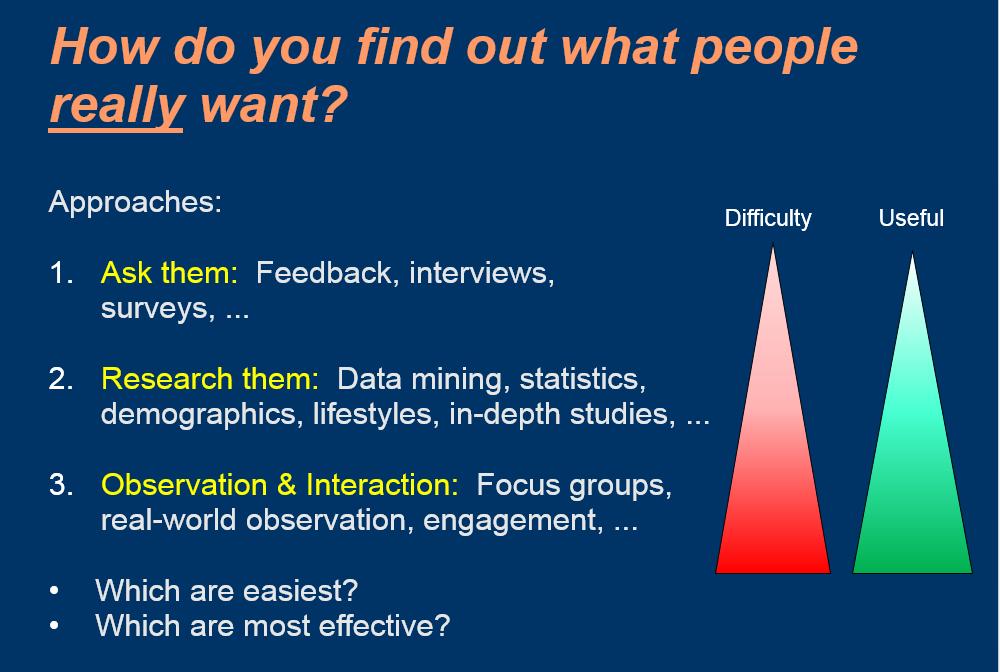
How do you find out what people really want?


Uncovering the truth is a messy business.

It means observing and engaging with your customers and allowing yourself to see deeply into their lives, gaining insights from their lifestyle behaviors, purchasing habits, and thinking.

It takes time, effort, strength of will, and allowing your own vulnerabilities to be exposed.

It means creating a connection to your customer so they will open up to you.

Would you like to see a master at work, someone who isn’t afraid to delve into his own emotions as he figures out what people really want?

Mad Men:  Don Draper and the Kodak Slide Carousel:

How do I build the skills and abilities to be like Don Draper?

The best marketers, as exemplified by Don Draper in Mad Men, must learn and develop more of themselves than simply their intellect.

Want to become like Don Draper?  Start learning and developing the following:

1.  About yourself (as noted earlier)

2.  Emotional intelligence – how other people feel, and why.

3.  The ability to feel emotions in yourself without pushing them down or getting overwhelmed.

4.  The personal strength to interact openly with others so as to engage much more of yourself with them.

These are life skills, really.  And perhaps engaging in life is the best way, if not the only way,  to learn these.

An exercise

As in Part 1, here is an exercise that can get you started on the path to expanding your skills and abilities in uncovering the truth about what people and customers really want.

1. Go to a coffee shop by yourself. Starbucks is a good one to begin with.

2.  Order your drink and get a seat where you can observe the lineup and at the same time be near other people who are sitting and drinking and chatting.

3.  Shut off your cell phone, shut off your laptop, remove your earphones, put down anything you are holding, and sit comfortably with your hands on your lap.

4.  Feeling a bit naked and uncomfortable?  Good!  You are used to being with friends, holding something, and being “plugged in” to your electronics.  Now you are alone, with no safety blanket and unplugged. You are a bit naked, no?  Sit with this feeling for 5 minutes or so.  What happens?  Are people looking at you, pointing their fingers and whispering to each other?

No, of course not.

As you come to realize that you are OK just sitting there, you will also begin to notice that your discomfort levels rise and fall, depending on what thoughts flow through your mind.  You may also notice that your mind tries to escape by going into stories, fantasies, or memories.  Gently return your attention to the coffee shop when this happens.

5.  Do a conscious observation:  Watch how people enter the coffee shop and line up to buy their drinks.  Watch how they stand in line, chat with each other, and how they interact with staff when it is their turn to order.

How do they behave? Where do they look? Do they seem comfortable or nervous? What patterns do you start to see emerging?

6.  Do another conscious exercise:  Listen to a conversation that is taking place near you.  Of course you cannot watch the people as this would be socially unacceptable (staring), but you can listen in. Or can you? Do you feel uncomfortable doing this? Why?

As you listen, sit with any feelings that arise in you. Are they your feelings being triggered by what you hear, or are you simply picking up the feelings of the people who are conversing, just as you pick up the heat of the sun when it shines on your skin?

As you listen to the conversation, can you observe your mind picking up interesting patterns and insights?  Can you hear your mind comparing what you are hearing to your own experience of life?

After 20-30 minutes of holding yourself separate from your habits and simply observing, you may find yourself getting mentally tired, emotionally upset , and even stressed.  Or you may find yourself in a new and exciting state of being, similar to a meditative state.  There is no right or wrong here of what you experience.  Be gentle with yourself if you do find this hard.  It takes practice to be by yourself and feel safe, strong, and open to hearing and experiencing the realities around you.

Question: How many times in the 20-30 minutes did you pick up your drink?  Was it a habitual movement, a nervous reaction, or simply a desire for a drink?  Be honest with yourself!

At the end of this exercise, walk out of the coffee shop and observe any feelings you have as you walk out. Relief? Exhilaration? Or feeling nothing?

Walk off the experience to clear your mind and emotions and reflect on what you learned.

Congratulations! You have practiced several skills and abilities that the best marketers have!

Are you ready and willing to do it again in another coffee shop?
The paradox of teaching “entrepreneurship”

I watched a video on entrepreneurship yesterday.

Well, actually, I only watched the first 10 minutes of the video – it was an hour long.

During those first 10 minutes, the very well-intentioned university professor attempted to intellectually conceptualize entrepreneurship and say something meaningful.

I gave up after 10 minutes of watching him struggle to bridge the gap between what he wanted to do and what entrepreneurship is.   He wanted to make something active into something passive.

The paradox of teaching “entrepreneurship”

Entrepreneur:  “A person who organizes and manages…”   (Dictionary.com)

There are two verbs in this definition: “organize” and “manage”.

These are active.  You organize and manage.  You do these things.

And you get good at organizing and managing as an entrepreneur by practicing organizing and managing. By independently daring to do the organizing and managing.  No-one gives you permission.  You answer to no-one. You initiate and do them yourself.

Like riding a bike, you can’t really study entrepreneurship in a way that makes it passive.  Well you, can. And you can study how to ride a bike, can’t you?

But in the end, you learn to ride a bike by…riding a bike.

And you learn entrepreneurship by…organizing and managing a business.

Which leads to the paradox:  Can you teach entrepreneurship?

Lorne Fingarson figured out how to teach entrepreneurship.

Homage:  Thank you, Lorne Fingarson, for inviting me to develop “curriculum” and “teach” in the Business Incubator Program at BCIT – The British Columbia Institute of Technology – from 1991-1993.

Lorne figured it out.  He convinced BCIT to deliver a program where entrepreneurs would get the learning and support they needed to increase their chances of startup success. His stats showed that with incubator support, he could get the success rate of business startups from 10-20% up to 60-70%.

But my “curriculum” and “teaching” in the program were anything but normal “university” lecturing.  Instead, at BCIT I supported entrepreneurs in learning the financial and marketing skills they needed for their businesses to be successful.  Not by lecturing, but by coaching them during their active “organizing” and “managing” of their businesses.

And that is the key difference:  The focus was on the entrepreneur and their business, not on me and my knowledge.

Student centered learning – the “flipped classroom”

When I first took a case-based business course during my undergrad, I was hooked.  Cases opened my mind to how the world works and gave me a chance to solve real problems. My MBA was entirely case-based.

And when we actually had to “do” a business in another undergrad course – actually make a business happen – I was ecstatic.

It is no wonder, then, that my teaching these last 23 years has been student centered.

In Dubai I led a team of faculty in creating something unique:  An entrepreneurship-based e-business bachelor degree program.  With the brilliant Tony Degazon in the co-pilot seat, we pushed and pushed to see how much we could get away with in a post-secondary institution.

Could we create an incubator-style program where students created online businesses?

We did!  And what an amazing Program!  From laying out their “classroom” (including painting the room and laying out the “office”) to choosing their own businesses that they actually started, our students were at the center of the learning.  This was the true student-centered, flipped classroom.

And it worked.

Back in Canada after 6-1/2 year in Dubai, I did two things:  Teach business part-time at a university and start my own businesses.

I wanted to organize and manage my own businesses for the sheer joy of being an entrepreneur and I wanted to share my passion for “doing entrepreneurship” in the higher-ed classroom.

The organizing and managing of my own businesses has been a wonderful journey, and often quite profitable.

The entrepreneurship “teaching”?

Kind of “hit and miss”.

Entrepreneurship and universities:  An awkward fit

Despite my best intentions, the fit was never a strong one between entrepreneurship – an active way of doing business – and the more passive study of business, as universities are set up to do.

Oh, I write lots of case studies for universities, colleges, and corporate trainers all over the world.

And in years past I got away with teaching an international marketing course primarily through my students creating real international businesses in their 14 weeks in the course. And again, amazing outcomes resulted.  One student team created such a successful business that they had to shut it down to finish their studies – it would take too much of their time.  In the end, the defacto team leader told me that she wanted to get her MBA because she wanted to work in a corporation, not run her own business.

A successful startup business...in an MBA Program marketing course
A successful startup business…in an MBA Program marketing course


(Oh the sometimes startling agony in being a teacher:  The most successful online venture from all the teams in all the running of the course and the business gets shut down because it was too successful and not what the student wanted to do!)

In the end, universities are set up to study things, not do things.  And no slight intended: The world needs things studied.  But so does entrepreneurship need a student-centred or “flipped classroom” approach to succeed. Perhaps not something that hundreds of years of history, process, and tradition, called the university model, is designed to support well.

We need more Lorne Fingarsons and more business incubators

Start-up weekends“, Lorne Fingarson,  business incubators, community support,  and $100 Startup’s Chris Guillebeau and his World Domination Summit entrepreneurial culture creation.

These are events, people, infrastructure, and cultures where entrepreneurship happens and where it can be “taught”.

We need more of these.

Bring it on!

A final note:

Lorne and his wife Pat keep on giving to BCIT.  Inspirational.

Starbucks got it right: Their “Third Place” works for me

A “Third Place”

When Howard Schultz was building the Starbucks brand, he wanted each location to be “a third place between work and home”.  To this day, I tend to spend lots of time socializing, reading, working, and drinking chai lattes in one particular Starbucks location. This one is the most comfortable coffee shop among the several I have to choose from in the urban village that I like to call home.  To be clear, not every Starbucks is designed and arranged the way this location is – spacious, warmly lit, comfy seating, and friendly.  But there are many locations, like this one, that live up to Howard’s vision and desire for Starbucks to be part of the communities they operate in – a “Third Place”.

Why a “Third Place”?

Every generation needs a place to be.  Not home, which is safe and nurtures who we are,  and not work which defines other feelings, such as labeling what we do. A third place, then, is a place where we can be in community with others, express ourselves, and transition between work and home so as to not bring one into the other.

“I want to go where everyone knows my name!”

(Cheers:  TV – 1982-1993))

“No one drinks anymore!” When I heard this statement , it startled me.  To the 50-something year old person who spoke it, local bars, taverns, and pubs were their Third Place.  When I was young the television show called Cheers was all the rage, beloved by many. In this sitcom, a group of people make a pub in Boston, MA their place to be.  For some reason, the show Cheers never really resonated with me.  To this day, I don’t really drink much alcohol and don’t associate it as a social connector between myself and others. I don’t have any particular beliefs or judgements around alcohol, to be clear.  Alcohol, and establishments that make it central to the experience, are simply not my Third Place.

The Club

“We are going to the [yacht/tennis/golf/curling or whatever] club.”  If you have a specific  activity, belief, or passion that you want to identify with, and want to spend time with others who like the same thing, these clubs are for you.  Once you are “in”, you feel like you belong and can “be” there. Wonderful! I am happy that people can find these feelings from such clubs. But while I do many activities, I don’t really identify myself with any one activity. I am not “a golfer”, for example.  In one startling experience, a checkout person at a department store stated to me “You are not a shopper, are you?” when I declined joining the store’s “points club”.  No, I am not a “shopper”.

The Library?

The venerable library, once quite a comfortable place to be for young and old  alike, is now an often uncertain mix of internet access terminals, videos, study space, and what feels like oddly outdated books.  It is a place to hang out during the day for people in transition,  the homeless and semi-homeless, and an eclectic mix of others who are not engaged in  a daily 9-5 job.  Can you “be” there? Sure. Many people make it their place to be, and the diverse mix of folks in a library make it an interesting place to observe human behavior.  But you are watched. Carefully. The central branch that I use has a security guard posted strategically so that you won’t steal videos.  And in the end, a library still feels like a library.  Despite having visited dozens of libraries around the world, I have only ever found one that didn’t feel like a library, but felt rather like a community “place to be”.  It was in Ohio.  I don’t live in Ohio.

Ahhh…the Community Center, of course!

What about public community centers? Well, some are really sports clubs. Others are places where seniors hang out and hobby courses are run in the evenings. Some, a rare few, actually have nice space to hang out – places you can “be” without paying to get in. Open lounges, couches,  activity rooms that don’t have to booked and paid for – you can simply use them. Nice.  I don’t have access to one of those kinds of community centers where I live.

A new realm

Young people have found a new place to be.  It is called “online”.  I have observed that they can be in your living room, but not “be” there with you. They are elsewhere mentally, socially, and in spirit.  The first time I experienced this in an extreme form, it stopped me in my tracks. A young person, who was visiting my son for a couple of weeks, was in my living room alone and in the dark.  This person was doing something on their laptop, with earbuds in place.

Said to me in a startled fashion when I said hello upon entering the living room:

“Oh, sorry. I am watching a movie with a friend in Toronto.”

In response to my utterly confused look they hastened to add:

“On this site we both watch the movie and we [text] chat with each other on the same screen.  It is like we are in the same room.”

The eyes went back to the laptop, the fingers continued chatting. I ceased to exist to them.  I stood there for a minute.  I felt like a stranger in my own living room.  Then I left the dark room, not quite knowing what to do there if I stayed.  In the time that followed during their visit I observed that rarely a live, in-person contact took place between them and myself.  However, online interaction seldom ceased, day and night. And it was not that there was any problem between us – it was simply that I didn’t exist in their reality. I was a ghost, floating in and out of their experience and occasionally startling them from their online interactions by speaking at them in-person.  And this, despite the fact they were physically in my home for an extended period of time.

The “connected young” make a significant part of of their life online.  In the extreme it seems the physical world is only a distraction from their “real” life online.  And while I find the online world enjoyable and useful, I don’t live there. It is wonderful to connect and chat online or by text message at times, but then the technology gets put down and I continue what I feel is my “real” life, in the flesh.

So, where can I “be”?

I am not a drinker. I don’t define myself by any particular activity or belief system. I do not see the current form of the library as a place I can be.  And I am not a senior who uses community centers – and won’t be for a long time.  I don’t live my life online.

So it has been Starbucks for me.  And it has worked pretty well.

A new place!

Today I visited a co-working space. Google the term “co-working” if you haven’t heard of what it is. This co-working space is a very cool place to work, hang out with independent peeps like yourself, and really feel comfortable in.  It has a coffee lounge complete with couches,  “hot desk” areas to work with your laptop, bike storage, lockers, meeting rooms, and more.  You pay for your time being in the co-working space, but unlike a commercial transaction, you pay a form of rent by the day or month that covers the cost of the communal space.  So you feel more like a citizen than a customer.  It is another place to “be” for people like me. Oh, and this co-working space is called The Hive.  As in “bee hive”.   Or “be” hive!  Delightful.

Now I have two “Third Places” I can be in. My favourite Starbucks, and a local co-working space similar to The Hive that I found the next day.

My lifestyle is getting richer.

My 10 hard-learned principles for starting a business

I am an entrepreneur.

marbles - games of chance and skill

When I was 7 or 8 years old I was running my own gambling game and market stall at my public school.  With glass marbles, dozens of us would offer games of skill and chance. If you could hit the tiny ball bearing with a marble, you would get a larger ball bearing or a crystal boulder (a large marble). Sometimes you would amass a bag full of “misses” when people tried to hit your tiny ball bearing.  And there was a clear ranking as to the value of all sizes of marbles, boulders, and ball bearings, one that changed regularly, depending on supply and demand. Besides the games, there was a brisk market for trading various types of balls based on these values.  Ten marbles might get you a crystal boulder, for example. Or on a good day, you might negotiate a better deal, only to trade it for a higher value deal the next day.  Then there were bullies who tried to steal your collection.  The school yard was pretty well policed by teachers, but without overt permission for this marketplace to take place, the market was basically unregulated.  When the inevitable day came when the games and market were shut down by the powers-that-be, there was a true sense of loss for many of us.  But then we moved on to trading hockey cards. One entrepreneurial addiction to another…and just 8 years old.

Living in a town where alcohol was the preferred choice of entertainment, I would ride my bike up and down miles of roads looking for empty beer cans and bottles in ditches.  What a great gig for a 10 year old! As soon as the snow had melted in the spring it was bonanza time:  A whole winter of drinking and driving throwaways were mine for the taking. That is, if Lou, the retired Hawaiian guy who lived across the street, didn’t get them first.  He was a real competitor:  Arising at 5 am, Lou would head to the backstreets of the industrial area of town where guys in cars would drink themselves silly, throw away the cans and bottles, and then drive on.  I had a secret weapon, however:  Lou would walk his dog. I would ride my bike.  So I had vast areas to scout for my glass and tin loot that he couldn’t get to.  But he was a clever guy: He knew that Saturday and Sunday mornings were the best days, after workers got paid their weekly wages on Friday.  I listened to his proudly announced techniques and learned.  I loved to learn how to do things smarter and better.

A clean driveway...
A clean driveway…

When I was a bit older my brother and I would cut lawns in the summer, rake leaves in the fall, and shovel snow off people’s driveways in the winter. Newspaper routes were, of course, also thrown in there for good measure during those years.

As a teenager I tried buying and selling comic books, which was a real money pit. I learned that the commercial trader bought comics at a pittance for what they sold them to me for. And of course when I tried to sell my collection, I was offered only this pittance. Once rid of that business, I instead learned about the horse racing and horse trading business (literally) from another neighbour. Another summer I worked in his greenhouse business, seeing what an amazing cash cow bedding flowers were. As the teenage years rolled on, I wandered through a handful of businesses, learning how the world worked:  Window frames, house painting, furniture manufacturing, building supplies, a department store. Of course, the teenage years meant wanting to socialize with girls, so I often held down 2 or 3 jobs and businesses at the same time. From Burger King to babysitting. I did it all. Money and having an excuse to hang around girls. Perfect.

My adult years meant a dozen more businesses: From importing water filters with my college friend Reiaz to buying bicycles from police auctions, tuning them up, and reselling them at a tidy profit in the spring.  Online businesses, consulting businesses, writing,  training, buying and renovating properties, selling door lites, distributing infra-red heating panels, keynote speaking, … and the list goes on.  All great learning experiences and deepening of my understanding of how the world works.

From 40 years of business successes and failures come 10 principles I base my new business ventures on:

1.  Is there any money in it?

Want to help others?  Volunteer.  I do, and it feels great to give from the heart.

Want to make money?  Always be sure to leave your “do gooding” feelings at home.  Is there little chance for significant revenues and profits in the short or long run?  Immediately and firmly shut down any attention to that idea.  Only start businesses where you can clearly make a good profit with reasonable effort.

And context is important here:  What is the scale of profit you want to make?  Doubling your money on a $50 sale sounds wonderful. But you can’t live on the profits from a $50 sale if you only make one sale a month.  Is this a “fun” business or a “pay the bills” business?  Being clear on the context of this business opportunity helps to put into perspective your expectations and how those expectations compare to the scale of profitability of the business.

2.  Are there enough possible customers who would want your product or service?

No guessing here.  Yes, you can prove there are enough customers or no, you can’t.  Yes?  Take the next step. No?  Stop that business idea immediately.

3.  Can they actually pay for it? And will they?

“Never try to sell something to someone who can’t afford what you are offering.” This is a paradox, because often in life those in most need can’t afford to pay to have that need met.  Even more subtly, many people who can afford what you have to offer say they can’t afford it and want it for free. Then they turn around and spend 10 times the amount of money on some luxury they want.  So clearly, there must also be a strong desire for what you have to offer –  a desire that is not a nicety, but a “here is my cash: give it to me now” kind of desire.

4.  Can you get them to buy your product or service?

Most of my business failures resulted from me not having the confidence, tenacity, acumen, and willpower to promote my products and services properly.  I always felt that a great product – one that offered excellent value – would sell itself.  True, if you have something unique and differentiated. Or something that people know well and want more of:  A Subway franchise, for example.  But false if you are just a “me too” business. Another standard offering. Then you have to work hard at promotion.

Marketing has been the most complicated and stressful part of all my efforts.  And I know it is for many others.

But now, I have a simple and clear question to guide me: “Can I simply and easily get people to buy what I am selling?”  Yes? Proceed. No?  Shut down that idea right away.  I will not engage in a “me-too” business, unless I can offer significant differentiation or access to a customer group that makes marketing clear and simple.

5.  Understand and offer what your customers want to buy, not what you want to sell.

You want to sell lawn cutting services.  Your customers don’t want their neighbours thinking bad thoughts about them because of an unkempt lawn.

Two completely different products.  Your view is irrelevant.  Theirs is always right.  Learn how the world works:  You are almost never selling a functional product or service. You are always meeting emotional needs.  Learn to speak to customers in a way that means something to them, not you.

So, I ask:  “What emotional needs am I offering to meet? Will customers pay lots of money to get those emotional needs met? Can I correctly and fully meet those emotional needs so that I can get lots of money in return?”

6.  Deliver excellent value, above and beyond what your customers expect.

Giving them everything you can think of?  Then find a way to give them more.

7.   Fire your worst customers right away.

I hated the guy who demanded his driveway be shoveled right away after it snowed, and then got his expensive car stuck trying to push his way through the snow piles, because he couldn’t wait for us to finish our shoveling work.   Instead he had us push him out. And when we were done shoveling, he told us to come back another day for payment because he didn’t have any cash.

Never, never do business with bad customers.  Fire them immediately or better still, simply say “no” to selling them your product or service in the first place.

8.  Pareto Principle your efforts

80% of your sales and profits will come from 20% of your customers.  Give those 20% of your customers your best attention and service.

80% of your work will come from 20% of your customers who make you no profit and give you all the grief.  Find out who those 20% are and get rid of them.

9. Buy low and sell high.

If you can’t buy low and sell high right away, don’t start the business.  Low profit margins never get better. They just get lower as costs go up.

And the key here is real margins: Not 10%, 20% or even 30%.  Never touch a startup business idea without a 50%, 100% or even 200% profit margin.  This is not greed, it is simply logical:  No real profits and you don’t have a real business. You have a charity. Great, if you are rich. Not great if need money to live on.

10.  Start right away and stop right away.

Start up your business at minimal cost and right away while you have hungry customers.  Even if you don’t have it all planned and organized perfectly yet.  Just do it.

And shut down your business right away when the customers don’t need you any more.  The moment your sales look like they are going to drop significantly due to factors beyond your control, shut down that business right away.

I learned this early in my career  I pushed for the sale of our first house only 6 months after we bought it and I had done a bunch of renos on it by myself.  My wife and all our extended family were shocked at the idea of selling and discouraged the sale.  To them, it was a home, something that you didn’t treat as a saleable asset.   To me, it was a freshly renovated asset in a market that had just peaked. Further, the cash from the sale of the asset was needed for our Masters degrees, something my wife and I had both just started working on full-time.

One month after we sold, the market plummeted, eventually dropping the value our house 25%.

Business decisions will often be unpopular.  But if you know when to start a business and when to stop it, hold firm and make the decisions, despite naysayers. Even if you are occasionally wrong, you establish a pattern of thinking, listening to intuition, and trusting yourself.  This is a confidence that is very, very valuable to you in the long run.

11.  Fall, get back up, and do something differently.

A bonus principle:  Expect to fail.  And then learn why you failed.  The only real failure is to not learn why you failed. If you do learn, then it is not a real failure, but rather a great learning experience.

And when you do fall down, get up right away and do something differently.

Entrepreneurs are not those who get their businesses right the first time. They are the ones who make 10 mistakes, learn all they can, and then succeed spectacularly the 11th time they try.

~~~~~~

A week after I wrote this blog post another question came to mind:  “Where did I make the most money from all these ventures?”

Buying houses, renovating them, and reselling them.  Hands down the biggest payoff in absolute profit terms.

In relative terms, for the capital and effort involved?  Selling myself:  Teaching in Dubai on contract was the most spectacular payoff, in cash, personal growth, and the lifestyle “wow” factor.

The most satisfying?  Collecting bottles and cans as a kid.  Every one you find, pick up, and return feels like a gift.  Is there anything more satisfying in business than feeling grateful when you make money?

~~~~~~

Photo credit:  Marbles, Flickr User: “Rebecca Barray”. Creative Commons Licensed, accessed February 21, 2014.

Travel, living, and learning: A recipe for life?

Why is travel such a deep calling for many people, myself included?

Why does our deepest self resonate with feelings that travel can trigger, including a sense of opening, expansion, learning, connecting meaningfully with others, and freedom?

Many years ago I posted a theory that travel is essential for learning, and particularly for children and teenagers. The theory posited that only travel could deliver certain experiences and learning opportunities, ones you could not get any other way.  To my surprise, I got a lot of backlash, particularly from mothers. Clearly not everyone agrees with my theory.

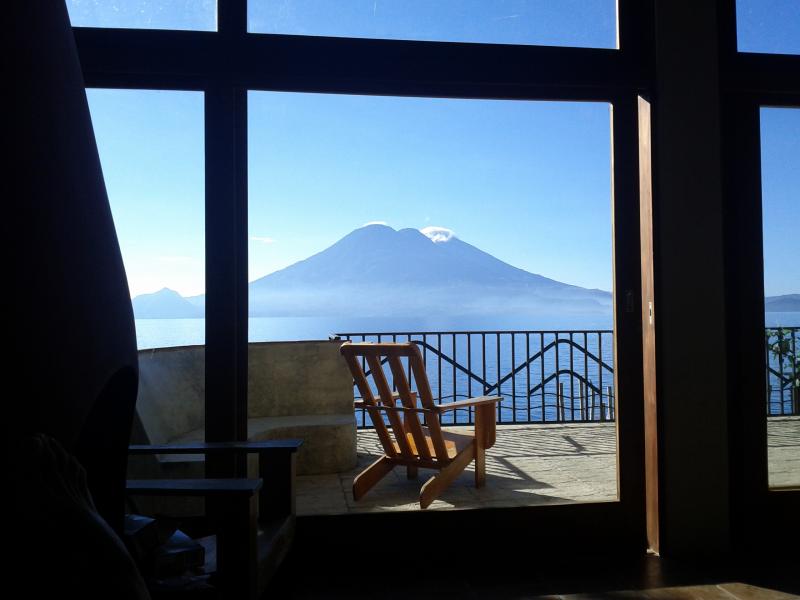
Over the years since I mused about the potential role and power of travel in our lives, I have come to even more strongly believe it is an essential part of a life lived fully.  Maybe it is just that my reality has formed from my belief – a self-fulfilling prophecy, so to speak. Or maybe my particular life path includes travel as a planned and useful part of my personal growth – part of my destiny. Regardless, travel is what I am called to do and travel is what I am doing…right now.  I am writing this while occasionally glancing out the window at a volcano (actually 3 volcanoes, if you look closely), on the shore of Lake Atitlan in Guatemala:

volcanosBut eye-candy aside, I am returning to the idea of travel as an essential part of life in order to gain some clarity on how it fits with living and learning my life. I am attempting to form some sort of recipe for my life, with travel as a central ingredient.

In comparison, there are many recipes for cooking food, and many different ingredients. But a few ingredients in cooking food tend to repeat across many or most recipes in a particular culture.  But are those ingredients foundation ingredients or simply spices that enhance the experience of life?  Hmmmm…interesting question.  For the culture I am from (“Western”), my stage in life (“past middle age”), and my personal growth path (“a rushing river”), my recipe for life seems to include a large dollop of travel.  But again, did I put that ingredient into my recipe, or it essential?

Case experience:  My first 10 days on this trip

The first 10 days of this trip have given me every indication that travel is delivering exactly what I needed and wanted.  In just 10 days:

– I have met a dozen interesting people who have expanded my views of the world:  Young Israelis who struggle with politics, how they interact with other cultures, and how to love.  A crazy-funny gay owner of a hostel who hits on all the male guests – myself included.  A Canadian couple constructing a life of travel and remote work (“digital nomads”).  A woman from Switzerland who is a distant relative of mine. A lovely young woman building a life for herself and her Guatemalan boyfriend between America and Guatemala. He is working on an organic farm on Long Island and Riley is spending a few months on an organic farm…in Guatemala.

– I have hiked past waterfalls, through vivid forest of flowers, and past banana leaves so vibrantly green that I thought I had never experienced such a color before.  I passed Maya women carrying huge loads of concrete blocks on their backs.  I greeted children with eyes and smiles so bright I wondered if I had arrived in paradise.  I stepped off the path to allow old men to pass, receiving a heartfelt (and sometimes surprised), greeting and thanks.

– I have shopped in traditional markets, buying new and strange foods using my basic Spanish skills, and a smile, and some proverbial scratching of my head. “How am I going to get a dozen loose eggs all the way across the wavy lake on a rickety, crowded, bobbing boat, without breaking them?”

– I swam many times in a beautiful lake surrounded by volcanoes (see photo above).  The first swim in the lake likened to “a baptism” by Riley.

Clearly, travel has been an ingredient of my last 10 days that has generated a veritable feast for my life.

The blessing… and the curse

It is so easy to make everything seem so wonderful in reflection. Most of my first 10 days have been wonderful, no doubt. But travel also brings a form of curse, one which must also be acknowledged and honored.  Also in the last 10 days:

– I have had the “runs” on and off for 5 of those 10 days. Nothing serious, just adjustment to new food, water, sleep, and energy patterns.

– I woke up in the night with my heart pounding and my arms and legs numb and tingling. This lasted a few hours until it passed and hasn’t returned since. (No, I don’t do drugs).

– I struggled with communication, working to improve my Spanish and feeling humbled once again for those who are learning a second language (read: my students).

– I had to regularly and consciously stay “centred” in order to flow easily through chaos of ever-changing conditions of my life. From moment to moment my life has changed in the last 10 days, something that can be hard on a psyche.

– I have had to put up with noise around me. Being sensitive to noise when I am tired, listening to construction noise from the villa immediately next to ours has been a minor irritant.

– My plans changed. And then they changed again. And then I let go of those and just went with what came up in the moment.  Travel forces you to be flexible, whether you are naturally so or not.  Resisting change is a quick way to blacken your work. Acceptance of change leads to wonderful new experiences (usually).

Each one of these “curses” I feel safe in saying were not daunting to me.  I overcame them pretty easily, flowing into my next moment with more grace than I have every mustered before in life.

Travel:  An essential ingredient for life?

Given the aforementioned analogy of the recipe, the last 10 days of travel have delivered me a feast of experiences, learning, and feeling very much alive.

So is travel an essential ingredient in life, such as rice would be in Asia, flour (or sugar) would be in North America, or beans to a Guatemalan?  Does travel create a life that is akin to a feast?

We like feasting on food. But we can’t feast on food every day. So, is travel an ingredient like in a food  feast? Wonderful to enjoy on occasion, but not something that we would be able to stomach every day nor would be good for us? What balance of stability and travel would be a healthy mix?

Questions for further consideration…

A daring idea: The recipe for a perfect restaurant

I am a foodie.  And I love eating at great restaurants.  And I love small businesses and the passion that people put into running their own restaurants.

Put all three of these together and you have someone who wants to see people who create wonderful food in great restaurants to be successful in all aspects of their business.

You would think that a restaurant, an institution that has been around for thousands of years, would be pretty easy to get right, wouldn’t you? But no. 60% or more of restaurants close within their first three years. In cities where there is a culinary arts program at a local college or university? Higher failure rates.

Why the high rates of failure of what should be a pretty simple business?

Because getting a restaurant “right” is something that is actually pretty tricky. So I am setting our here to define what makes a perfect restaurant – one that has great food, is a place you want to hang out with, has wonderful people running it. and is successful in all ways.  Here it is:

The recipe for a perfect restaurant

1.  The perfect restaurant understands its customers really, really well. It knows that there are enough potential customers in the geographic area it serves.  The perfect restaurant knows what kind of customer they are – what kinds of food they prefer, at what prices they will pay, in what kind of setting they enjoy being in, and how they like to be served.

Common mistakes:

– Focusing on what you want to offer, not what the customer wants:  “I want to offer really lovely entrees like I learned in culinary arts school.” It is not about you. It is about the customer. Always.

– Wrong price range: “We will serve the highest quality experience, but it will be high priced as the “best” costs more to produce and deliver. ”  But are there enough customers willing to pay for the high prices for your meal experiences?

– Wrong process:  “We have a cafeteria style restaurant serving high end food with little signage. We will save money on servers. People will figure it out our process on their own.” No,  customers won’t figure out the process on their own and the discomfort they go through in trying to figure out your process will be the first emotional impression they have. And it will stick.  And if customers want table service? You will be out of business really soon.

2.  The perfect restaurant makes their customers feel really, really comfortable in the restaurant. This includes, but is not limited to:

  • nice warm lighting
  • appropriate decor
  • clean smelling and looking
  • fresh appearance (not dated)
  • enough privacy for each table – specifically psychological privacy and personal space
  • friendly and welcoming greetings upon arrival
  • a clear process for being seated
  • comfortable waiting arrangements if there is no table free
  • clearly understandable menu and ordering procedures
  • clear payment processes.

Common mistakes:

– Uncared for internal and external appearance:  An ugly, dirty, dated, smelly, and/or dark and gloomy setting.  Enough said.

– Unclear processes:  People get really uncomfortable when they walk in and are not greeted, don’t know if they should seat themselves or be seated, what the menu means, how to order, etc.  This first emotional impression of discomfort (not wanting to look stupid, being potentially embarrassed, etc.) really sticks. A bad first impression to make.

– Process oriented service:  A restaurant meal is not a drive-thru. People want to be promptly greeted immediately upon entry in a warm and friendly manner.  All aspects of service should include warmth, friendliness, caring about the meal experience, and appreciation of the customers patronizing the restaurant.

3.  The perfect restaurant makes food that meets customer expectations.

Really! You would think this would be a no-brainer!

Common mistakes:

– small portion sizes.  No-where in the world does small portion sizes  meet customer expectations, except in a few rare and really fancy places.  But those are the very rare exception. Small portion sizes = a focus on taking my money and giving me the least possible for it.  Generous portion sizes?  “You wish to provide abundance.  Thank you!”

– beliefs-driven food that limits the customer’s sense of value.  This includes small portion sizes, food that doesn’t satisfy (“But is is low fat and low salt!”), a partial meal that does not offer a complete food experience, freaky dishes that taste weird, and food that is overly expensive “because ingredients are locally sourced.”  No, don’t try to argue this.  If your values are to promote organic food, and if there are enough customers who will pay for organic food, hurray!  If there are not enough customers willing to pay your prices,  in your catchment area, don’t offer high priced organic food.  Don’t want to run a restaurant unless it is organic but you don’t have enough customers?  Don’t run a restaurant at all. Save yourself the bankruptcy costs now.  Offer your gift of organic food to your family and friends… only at home.  Do something else with your time and passion, but don’t run a restaurant driven by your values if there simply isn’t enough demand for what your values dictate you must offer.

– food that is yucky. Poor tasting, poor appearance, bad ingredients. Enough said.

4. The perfect restaurant is set up for financial success.  This includes:

  • Being in the right location.
  • Having a manageable overhead (rent)
  • Having enough tables.
  • Having enough working capital after the restaurant capital expenses.
  • Knowing how to advertise and create word-of-mouth awareness.
  • Having enough staff to run the restaurant properly, but not too many.
  • Knowing how to manage ingredient ordering to maximize freshness and availability, but limit waste.

Common mistakes:

– wrong location:  “But the rent was cheaper here!”. Yes, but if you have no customers, who cares if your rent was cheaper?

– too high rent for the type of restaurant:  It takes a zillion orders to generate enough margin to pay for high rent, if your meals are low-priced.

– cutting corners:  Raw materials ordering to maximize savings instead of freshness, small portion sizes, too low staffing, narrow opening hours, cutting out lighting & heating, not cleaning thoroughly, not renovating & updating often.

Does the perfect restaurant really exist?

Absolutely. I frequent many that get it right – they are perfect restaurants.

I just wish that the restaurants that aren’t perfect would frequent the ones that are perfect, and learn from them.

The Digital Nomad comes home…

It has been about a month since I returned from my Digital Nomad experiment of working and traveling in Guatemala. I came home from this adventure and did three things all at once:

  1. Moved to a new city
  2. Started a short Christmas contract job at an old employer.
  3. Attempted to adjust from one lifestyle to another.

The move to the new city went ok.

The Christmas contract job was really challenging.

The adjustment from my much freer lifestyle to my new, more fixed lifestyle was largely a failure.

To be fair, trying to adjust from sun, warmth, freedom, and flow to dark, cold, process-driven, and mechanical thinking would be a fairly big challenge for anyone.  But for me it was soul crushing because I had made the mistake of really falling in love with my Digital Nomad experience. And I had unconsciously pinned my happiness to this more natural way of life.

All this led to New Year’s reflections where I beat myself up mentally over my choices, got really frustrated at my current situation, and pondered some really juicy “thrashing around” fantasies.

Lessons for a Digital Nomad

Being of generally sound mind and spirit, and a happy soul, I soon came out of my funk. Clarity felt good and so did some resulting insights:

Pig Escape
“Once you let a pig out of the pig pen…”

1.

“Once you let the pig out of the pigpen, he will never again be happy in the pigpen and will from then on always try to get out again.”

Yup, the old farmer’s wisdom.  Well, I got out of the pigpen and must now work on making the Digital Nomad lifestyle, or some variant, my permanent reality. There is  simply no choice for me. Really, the experience of a freely roaming lifestyle with digital connectivity is intoxicating: Breakfast of fresh food grown locally while sitting outside in the warm sun in your sandals is simply better living than breakfast of dead food in a dark, cold kitchen in thick wool socks.

Do you like the winter “nesting” experience? Fill your boots. I will take the warm sun, thank you, as soon as I sort out how to be out of the pigpen permanently.

Grass IS always greener!
The grass is always greener on the other side of the fence…isn’t it?

2.

“The grass is always greener on the other side of the fence.”

This lovely farmer saying about grazing animals wanting the grass on the other side of the fence – but that it is not really greener – is so true…and the saying is also very, very dangerously misleading. I feel it has imprisoned so many minds that I am called to challenge it here.

Two important hidden assumptions:

– There is actually grass on both sides of the fence

– You are a grass eater.

The true part:  If there is grass on both sides of the fence, and you are a grass eater, then you could quite well be fooling yourself to think that if you get on the other side of the fence the supposedly greener grass will make you happy.  It won’t. The grass isn’t really greener because you never really wanted green grass anyway – you wanted happiness. And finding happiness is entirely an “inside job”, as my bumper sticker says. This is a spiritual truism.

Similarly, if you want to be a Digital Nomad and think that being in the warm sun will make you happy, you are fooling yourself. Nothing can make you happy.  Not the warm sun, fresh food, …nothing.

BUT, what if the two hidden assumptions are not true, and you are pretty clear and happy already?  In other words what happens if:

– There is wheat growing on the other side of the fence and grass on this side of the fence.

– You are a wheat eater?

Does the saying hold true of you?  Of course not! If you are a wheat eating animal, grass will never be your “thing”. You might be able to survive by eating grass on this side of the fence, but you would literally be healthier and feel more natural on the other side. Note: I am saying “healthier” and “feel more natural”, not “happier”.

What nurtures you?
What nurtures you?

Similarly, then, if you are really a sun-bunny who thrives better on fresh food, go where it is sunny and you can get fresh food.

Your guru, your mother,  your best friend, and the smug person in the cubicle next to you all tell you to stay where you are and work on being “happy with what you’ve got”. They are actually all working from a stunted mind frame: They are “inside” a mental box where there is only grass on both sides of the fence, they see themselves as grass eaters, and they are not really free and happy, so neither should you be.  If you let yourself out of the pigpen and have sorted out your internal happiness, you are free to go wherever suits you.

Enjoy whatever part of the world and whatever circumstances feels best to you at any point in time.

3.

“A thought is harmless unless we believe it. It’s not our thoughts, but our attachment to our thoughts, that causes suffering. Attaching to a thought means believing that it’s true, without inquiring. A belief is a thought that we’ve been attaching to, often for years.”  – Katie Byron

I failed at making the transition to a life back “home” because I had let myself out of the pigpen (and can never go back), I had learned conclusively that I am a wheat eater and there is little wheat on this side of the fence, and lastly, because I had attached to thoughts and that attachment wasn’t healthy for me.

And those thoughts were that I had already made it to the side of the fence that was the most natural and healthy for me. In my mind, life in the warm sun of free-flowing Guatemala right now was my truth.  Of course it is not!  What is true is that I am a sun bunny and love a free flowing daily existence. But that is not exactly my current life setup. It is where I am going and will hopefully spend most of the rest of my life, but it is not where I am right now.  But I believed it was my current truth and that belief made me suffer.

Lesson:  The Digital Nomad lifestyle is about freedom, experiencing contrasts, learning from those contrasts, and living your day-to-day life in a way that is natural for you.

But don’t attach to the form of that life. Don’t believe your own thoughts that it must look one way for it to feel a certain way. This is the unhappiness trap. “I was happy in _______. Therefore, since I am experiencing a current reality that is different, I am unhappy.”  To stay in my integrity with where I am right now is important as I have responsibilities to see through to their natural end and doors to close before I can be fully free to live the way I want.

I will not stay for long in the cold, dark, process-oriented, mechanical thinking reality I am in right now. But at the same time, the fastest and easiest way to end up where I need to be is to not get attached to, or believe that I know the right place,  circumstances, or timing. These will happen if I trust and stay true to who I am.  I must simply be happy inside myself,  know who I am, and remember what feeds me best. From this place of peace and understanding will come steps and actions I will take that will move me towards the healthiest and most natural circumstances for me.

The Digital Nomad – a lifestyle and a philosophy?

~~~~~~~~~~

Photo credits: 

Pig photo:  Creative Commons Attribution-ShareAlike 2.0 Generic license, “Chasing the escaped pig”, Flickr user:  pauldwaite, accessed January 8, 2013

Goat photo:  Creative Commons Attribution 2.0 Generic license, “Goat and Fence, Heritage Vineyard”, Flickr user: Tony Fischer Photography, accessed January 8, 2013.

Breakfast photo:  Creative Commons Attribution 2.0 Generic license, “A beautiful and healthy breakfast”, Flickr user:  The Sean and Lauren Spectacular, accessed January 8, 2013.

Guatemala: Wrapping up an adventure

Most people in this world do not get to take a whole month off of their regular life, much less head thousands of kilometres away by plane to another country to be Digital Nomads, explore, write, meet wonderful people, and play.

So I start this final post about our Digital Nomad adventure in Guatemala on a note of appreciation.  I am truly thankful for this opportunity to explore the wonderful country called Guatemala, the amazing people who make their lives here, and our fellow travellers, among whom I now count many new friends.

10 things I appreciate about Guatemala and our adventure here:

1. The feeling that you are in a very special place in the world.

2. The amazing vibrancy of life here – flowers, fresh produce, animals, people of all walks of life, and even the air. Yes, even the air feels vibrant.

3. I follow the Buddhist philosophy of greeting everyone who comes into my experience with an open heart. Of the hundreds of souls I have greeted here, a smile and cheerful greeting was returned to me in almost every case.  Magic.

4. Food.  Eating food made from fresh ingredients and prepared with care from scratch was an amazing culinary experience in Guatemala.

5. Lake Atitlan. The author Aldous Huxley waxed eloquently about it.  I echo his sentiments. Lake Atitlan is both visually and spiritually a breathtaking place in this world.

6.  The climate.  Ahhhh…warm and dry.

7.  Ease of doing things here. Whether is freedom from mosquitoes, clearing the airport, shopping for food, or exchanging money at the bank – getting things done is pretty easy here. OK, driving doesn’t look like fun, but buses, boats, and tuk-tuks are available everywhere, and so cheaply, that it doesn’t make sense to drive yourself.

A dinner companion
A dinner companion. Guatemala is a place of freedom…you can eat with whomever you wish.

8. The man who brings goats around every day and who will squeeze you a cup of fresh milk on the spot.

9.  A human place.  A place where human beings seem to fully live their days and connect with each other authentically. People here in Guatemala, whether locals, expatriates, or visitors, aren’t living in a fantasy-land. They are fully engaged in what is important in life.

10.  Freedom. You can experience real freedom here. Freedom to have a cat sleeping on your lap while you eat dinner. Freedom to connect with others and get a desire to connect in return. Freedom to live naturally.

Thank you, Guatemala!

Paul and Alex - Antigua
Alex and I at the end of our wonderful time in Guatemala.


The Digital Nomad: Relationships

One of the more challenging aspects of living a free life is knowing how to go about being successful in all you do – working, travelling, and living your life every day. I would argue that relationships are the keystone to a successful Digital Nomad lifestyle. Connecting to people every day in some meaningful way is necessary to both your ability to function and to be happy.

Some scenarios to illustrate:

John, a moderately successful entrepreneur, 36 years old, single, speaks only English

“I prefer to roam in better countries in the world. I might visit Italy and Greece for a couple of months this year as they are struggling financially and this means I can stay in great hotels and eat well. I am not cheap, but having worked hard to build my business and be personally free, I don’t waste money, either. I do about 10 hours of work a week managing my businesses remotely, primarily by telephone and email to my employees in Canada. It is amazing what you can see and experience when you visit Europe. Not a day goes by when I don’t run across an event, historical marvel, or a restaurant serving delicious food.”

Mary, an NGO logistics coordinator, 42 years old, in a differentiated relationship, speaks 3 languages

“My experience with the independent lifestyle is one of real freedom. I work part-time for an NGO which operates in 35 countries in the world. My speciality is in connecting people and resources to have our operations take place smoothly. This might mean preparing and guiding a group of volunteers who are providing medical care after a natural disaster, or it might mean setting up a school in a vibrant but poor community somewhere in the world. In all cases, the greatest satisfaction comes from the people I meet and work with to make the logistics happen. Sometimes I am invited to stay with families of our local contacts and end up having wonderful connections – people I now call life-long friends. Other times it is the volunteers who I have a marvellous time with. But in all cases, whether I am working or just enjoying the places I am once my work is done, it is the people that make this an amazing lifestyle.”

Prakesh, receives a good income from an online businesses, 29, single, speaks 2 languages and learning a third.

Who would want to walk this beach in Brazil alone?

“I am a first-generation American, born and raised in New Jersey. After receiving my degree in engineering I chose to start some online learning programs for ESL learners. These now provide a nice income for me to explore the world with. I travel for about half the year, spending time in amazing places and getting to know amazing people. While I am officially single, I do meet up and travel sometimes with someone special who I met in Argentina a couple of years back – a fellow free-spirit. I know that I am not an island – relationships are important to me. In fact they are in my blood, so to speak, as my very tight-knit family is from India, originally. So besides my wonderful travel companion, I also tend to spend time in homestays, hostels, and family run hotels where I can get to know people. I give wherever I go, too, whether it is helping with some technical problem or sponsoring a student. This spirit of giving results in wonderful friendships wherever I go. I won’t always be a digital nomad. In a few years I would like to have a family and this will mean more geographic stability. But after those years, I hope my wife/partner will join me in our later years for more fun exploration of the world and connecting to wonderful people.”

A few thoughts about John, Mary, and Prakesh

Which of these people do you think will be the most successful in the long-term as a Digital Nomad?

I would argue that Prakesh has the best chance of having the best experience. Why? Because he strives for balance, knows that nothing lasts forever – including where he is in his life stage right now, and knows that people and relationship are a foundation to his success, including a clear relationship with himself.

Mary will also have a successful time, seeing relationships as both a cornerstone of her success in her job and as a fulfilling part of her life. However, do you see that Mary does not have as well-rounded a perspective, perhaps, as Prakesh?

Finally, I would suggest that John’s archetype, the lone ranger, while a nice romantic vision, is not sustainable emotionally or logistically. He is enjoying the rewards for his hard work as an entrepreneur, but does not have a well-rounded understanding of himself, his life path, how to connect to the world (one language, a tourist approach to travel), and is missing the key ingredient: People. Being a lone ranger is not a sustainable mode for being a Digital Nomad.

Relationship principles for a Digital Nomad lifestyle

The following are some human relationship principles I would suggest can serve you well as you go about creating your ideal roaming lifestyle:

1. You are not an island.

Daily meaningful interactions with people are essential to your mental and emotional well-being. If you come from a family or social sphere where distant connection, high personal boundaries, and much privacy is the norm, then moving towards closer connections with people you meet might be a bit of a cultural challenge for you. Or it might not find it hard: You may find that you have been starved all your life of the kind of connections that feed your soul and will be a social bunny rabbit when you find yourself in more relationship oriented countries. In either case, prepare now to be more socially connected in a Digital Nomad lifestyle.

Tips to help the transition:

– Learn more than one language so that connecting with people other than fellow travellers is doable. If you plan on spending a lot of time in Europe, French and/or Spanish would be good bets. If Central or South America is on your radar, Spanish is essential. Asia? Tougher to learn a second language, possible and recommended if you plan to return many times and for many years. Some people visit Japan, for example, and 5 years later they find themselves both fluent and surprised that they stayed so long.

– Ease into closer connections. Start by travelling with a friend. This will buffer the raw shock of connecting so quickly and closely with people in the countries you visit. When you stay in hostels or hotels, try shared bathrooms instead of private. This will help you feel less self-conscious as you internalize the reality that you are not alone in having to share space and facilities and your toileting and cleaning processes are just the same as everyone else’s…and no-one is watching you.

– Eat at a mix of local and expatriate restaurants and be OK with it. Purist travellers insist on eating only at local cuisine restaurants and sneer at “tourists” who eat expatriate food. Don’t waste a second listening to them. Ease into local foods and restaurants gently. Like personal hygiene, food is a very special part of our grounding and connecting. Eating at restaurants run by expatriates and serving food that you are familiar with is a great starting point. And you will naturally run into others from your culture who you can connect to. Often a group will be heading out to dinner at a local restaurant and you can join them – again having a buffer to start getting used to connecting with unfamiliar foods, restaurant processes, and peoples.

Learning to make rich connections with people wherever you go is not something that happens easy for some people. If you fit this personality then go easy on yourself. What we are talking about here is not becoming an extroverted party animal, but rather to be open to connecting authentically and naturally with people in any culture and place, something that everyone can learn how to do.

2. Most the world is relational.

Only a few countries – led by the U.S. – espouse individualism and independence very highly. To get things done in the rest of the world, people and relationships are key.

Here is an example of how it works:

Lev, an Israeli-American visiting Guatemala for the first time, saw a wildlife park in a guide book and decided to visit it immediately. He read about the route by bus in the same book, found his way to the bus stop on his own, paid, and rode 1-1/2 hours by bus to the park. Upon arrival he found out the park was closed that day, something he didn’t read in the guidebook as it was currently off-season and the park wasn’t open 7 days a week.

“Why didn’t someone tell me?” Lev said to me in exasperation when relating his tale. “I wasted 3 hours on the bus!”

Do you see what happened? In North America, we are used to using guidebooks and the internet to figure everything out – we independently take initiative to help ourselves make things happen. We have learned that we can do thing faster and with fewer interpersonal slow-downs if we take control and do it ourselves.

When is the boat coming?
When is the boat coming? Maybe I will ask someone…

And there is no problem with this way of doing things…in North America and much of Europe. Systems are designed to work well for independent action. As most people know, trying to phone a chain store to confirm if they are open, for example, is exasperating: Phone self-serve menus are designed to give you everything they think you need…except being able to talk to a live person.

Most of the rest of the world is set up with the expectation that people will naturally be the system you use to get things done. Everyone expects you will ask for help and they are quite willing to help you. Of course, if they need help, they will expect you to help them as well, something that can make those from highly individualistic and independent culture squeamish!

Result?

To get things done in most of the world, ask people about most things. Get to know them a bit and they will help you. Offer to help them with something and they will go out of their way to ensure you get what you need done and make sure you know the best and safest way to do things.

Go back to Lev’s situation. Notice that he didn’t actually talk to anyone?

Interesting insight and useful tip?

Aural and vocalizing (hearing and speaking) are central to the relationship orientation. As I was taking a local inter-city bus in Guatemala, I noticed that there were two people running the bus – the driver, and the “caller”. The driver managed the chaos called driving in the country. The caller, on the other hand, leaned out of the bus door and loudly called the destination of the bus as it came to various stops. Yes, the country has a high illiteracy rate, but the destination was boldly and clearly written on the front and even if you are illiterate, you would probably be able to learn basic patterns of words such as city names.

Then the bus came to a stop and as the caller shouted the destination, two people who were talking to each other jumped up and ran to the bus. They were not waiting at the stop looking down the street for the bus (a process orientation). They were not lined up the stop to be first on the bus (a goal orientation). Instead, they were were sitting talking to each other, and when they heard the caller, they got on the bus. They were relating to each other first and foremost.

This may seem a simple example, but it underscores how life is in a relational culture – you are in connection to one another and people connect vocally (the bus “caller” in this case) to let you know when you need to take action.

Tip: Get used to relationships and how they work before travelling in highly relational cultures, particularly. And get used to asking and listening more than trying to figure it all out yourself. You will avoid a lot of mistakes, frustration, and irritation.

Being relational is just how most of the world works.

3. You will change…and so will your relationship needs

You don’t become a Digital Nomad and stay that way for life. It is not a lifelong profession or spiritual philosophy. It is only a lifestyle, albeit a pretty awesome one.

What happens when you enter a different life stage and context, triggered by one a number of possible situations?

  • You enter a relationship that you feel will lead to starting a family or some deep inter-personal learning together.
  • You find a place you feel incredibly at home in.
  • You connect to a group of people doing something in one place – you find your tribe.
  • Your aging parents need more support.
  • You join an organization that needs you to be in one place.
  • You feel you would like to be more grounded in natural rhythms such as growing your own food.
Worth hanging up the boots for?
Worth unpacking the travel bag for?

I have seen many people try to brave on with their Digital Nomad lifestyle even when their life is changing and it is time to put the travel guides on the bookshelf for awhile. In most cases, when your life changes significantly, digital nomading simply doesn’t work any more. It doesn’t work for a while, or even for a very long time. A high need baby, for example, doesn’t dovetail nicely with your taking a red-eye flight to Bangkok for some late night bar-hopping with friends. It simply doesn’t work.

The biggest relationship shift seems to be one of moving from a very free flowing mode with few relationship responsibilities to one of commitment to a relationship which requires your consistent presence. This can be a new love relationship, the arrival of a baby, the illness of a family member or parent, or even, in one memorable example, where someone with a terminal disease asked a close friend to stay to be with him when he dies. All powerful reasons to unpack the laptop and toiletries bag for awhile.

Understanding that the nature of your relationships with others will evolve over time and your relationship to yourself, too, is essential to living the Digital Nomad lifestyle happily and successfully right now.

‘”Carpe diem” – “seize the day”. Tomorrow will be different. And that is OK.

Guatemala: Raw material for creating an amazing expatriate life

I came on this trip to Guatemala for many reasons. One was to explore the Digital Nomad lifestyle – living somewhere warm, beautiful, and inexpensive while working remotely via the internet. A related reason for spending time in Guatemala was to check it out as a possible expatriate lifestyle for my 50’s decade. Having lived abroad and travelled widely, I am not naive enough to simply jump at the first place that offers sun and a friendly people. But I have to say that Guatemala offers a lot of raw material for creating an amazing expatriate life.

 Some random insights on this theme

Food - beautiful, delicious, inexpensive food. Guatemala.
Food – beautiful, delicious, inexpensive food. Guatemala.

– Almost everything is very inexpensive here. Food, accommodation, real estate, help, travel, …all of it. Great for anyone who wants to live a simple life on a modest income. And no sales taxes! I can’t believe how delightful it is to pay Q.35 for a nice breakfast…and your bill is Q.35 ($5). That’s it. Just a tip to add on top.

– Yesterday we were walking to a neighbouring town and got stopped by a small crowd in front of us. Someone said the president of Guatemala would be speaking. So we hung around for a bit and sure enough, 30m in front of us, the president of Guatemala got up on the stage and gave a speech dedicating the funding for an expanded highway to the town. It is not everyday in North America you can run into such an experience. I jokingly called it our private Spanish lesson given to us by the president of Guatemala. The point? Since we arrived here magical stuff like this has happened. Experiences you simply can’t get sitting at home in North America watching TV.

– Expatriates, travellers, and locals do not sit at home watching TV in the evening. They are out and about in the warmth during the day and in evenings, working, connecting, sharing, learning, and enjoying time together. I appreciate that it is cold in the upper half of USA and Canada for at least 1/2 the year, limiting your ability to simply wander around and meet people, but I feel it goes further: North America is a very goal oriented society. You feel you should always be running around doing stuff. Shopping, going for a run, cleaning, working, building, etc. Homes and cities are designed to support this goal oriented mind frame, rather than a connective, relationship-oriented mind frame and lifestyle. Here in Guatemala, the year round warm weather and relationship orientation makes connecting by wandering around outside easy, natural and expected. Sign me up.

– Food. An amazing abundance here. Prepared from scratch for you at restaurants, with resulting tastes and substance that is fulfilling. And available at markets cheaply for your own cooking. Fresh, wonderful, healthy food.

 Contributing

Before our trip my son and I checked in with a Rotary group who are doing some development work here. I have a soft spot for Rotary as they sent me on an exchange trip when I was a teenager and whenever I get a chance to contribute to their mission in some way, I jump at the chance. This time, the group will be putting in concrete block cooking stoves into the homes of very poor locals. These stoves dramatically improve the air quality in homes while cutting raw material (wood) costs to a fraction of what was used for open fire cooking. A great mission and though I am not directly involved in this effort, a great opportunity for me to see how this might work.

The reason for my backdrop Rotary story is a funny coincidence. At the end of my Spanish lessons in San Pedro, my teacher and I visited a very small, one-room local home. More a shack, really, about 4m x 7m in size, with 4 children and their parents. One bed for the parents, mats on the floor for the children, and a seating area for eating. No running water, I didn’t see electricity, and few possessions. Of course, as you might expect, beaming smiles and friendliness everywhere. But to my delight was one of the stoves Rotary will be putting in! The exact model, and being used just as I was visiting. Not one to miss an opportunity to learn, I found out that they really work well, it uses a fraction of the wood of an open fire, and it keep the air really clean. The mother was super happy with it and expressed her delight in Mayan and a bit of Spanish…and of course with a beaming smile.

Go Rotary! These stoves work.

This afternoon

So, you would think that this Rotary story is done, right? Well, I wrote this posting early in the morning, after spending some time enjoying the sunrise between two volcanoes.

Santa Cruz Hike
View along the hike from San Marcos to Santa Cruz – one of the most beautiful vistas I have ever seen.

Around 11am today, Alex and I decided to hike from San Marcos to Santa Cruz, a 3 hour hike. The roads ends at Tzununá, a tiny traditional town a couple of km from San Marcos. As we walked into Tzununá the road turned right or left. Coming up the path from the right was a person who was clearly a Westerner. I asked him the way to Santa Cruz. He cheerfully offered to to show us the way and we walked together for a few minutes. Naturally, I asked him where he was from. To our surprise, Victoria, BC, where we are from. And as he talked a little about his time here, I sensed something fishy and asked if he was a dentist. Yes.

This was John Snively, who was to be our Rotary contact in Guatemala and who I had emailed from Canada. Nice to meet you, John.

Magic just kind of happens here. Get ready for it if you plan to visit Guatemala. And enjoy the magical journey.

Oh, and the hike to Santa Cruz should not be missed. Spectacular.

Being a Digital Nomad: Can you actually do the ‘Nomad’ part?

Digital Nomading sounds fabulous. Check out this quote from book The $100 Startup, by Chris Guillebeau:

“Packing a carry-on bag with running shoes and two changes of clothes, I head into the world via a short connection from Portland to Vancouver International Airport. Later that evening, the twelve-hour Cathay Pacific flight to Hong Kong gives me two hours to watch a movie, six hours to sleep and four hours to write emails.

Arriving in Asia, I clear immigration (no bags to claim), check my wallet to see if I still have local currency from the last trip here, and settle into a concourse chair before jumping the train into the city. I flip open the laptop, connect to “HHG-Free-WiFi”, and log onto the world. Woosh…out go all the emails I wrote on the plane and in come 150 more that arrived during the night.

…After I adjust to the time difference over the next couple of days, I settle into a routine of morning work and afternoon exploration. At least one week a month, I live this dream world of travel, work and frequent coffee breaks. The business is structured around my life, not the other way around.” (page 57-58)

Chris is not the only one to expound the possibilities of an amazing life as a Digital Nomad.  Tim Ferriss, of the 4-Hour Work Week fame, does as well, suggesting that taking a month or more of time abroad is not only doable, but desirable.

Can you actually do the ‘Nomad’ part?

Sounds great doesn’t it? Just surf the systems of the world, experiencing countries, peoples, lifestyles, and places while doing your work digitally.

San Pedro at Lake Atitlan in Guatemala
Lake Atitlan – yup, it is really beautiful…and warm!

So here we are in Guatemala, finding that yes, some of this is absolutely true. While back home on Vancouver Island it frosted the other night and is typically rainy, dark, and cold this time of year, Alex and I are sitting under palm trees in San Pedro,  Guatemala in beautiful sunshine, connecting to our hotel’s wifi connection and working digitally.  Oh, and our nice little hotel costs $12.80 a night, breakfast around $9 for the two of us (we splurged at a nice place), and this afternoon, when our work is done, we will go kayaking on gorgeous Lake Atitlan, where our hotel is on the shore of. Kayak rentals: $1.25 per hour.

Ready to fly down and join us yet?

A must:  Understanding the context and setting the stage

Wait a minute! You know deep down that nothing is ever perfect. The grass cannot be greener on the other side of the proverbial fence. Life just doesn’t work that way.

So what is wrong with the pictures Chris Guillebeau and I painted?

First, the context:

Did you notice that Chris does not mention family? I don’t know his personal situation, but would you be able to jet around the world one week a month if you have a teething 6 month old at home? Or a spouse/partner who you have created a geographically grounded life with?  Or when your 3rd child is having their first dance performance next week. “Sorry my dear! I’m off to Guatemala. Mommy will video it so I can see it when I get back from playing abroad!”

Do you see the reality of most people’s lives in contrast to a Digital Nomad’s?

Being a Digital Nomad means you are free of geographic, fused relationship, and mental constraints.

Geographic:  You must be free of a job that specifies you be in one place. And a residence that ties you down with maintenance, security, and/or high costs. And no dogs or cats who need your attention. And few or no community or civic commitments.  You must be separate enough from your “home base” to be free to travel and “digital nomad”.  How many people are ready to live like this? Can you feel the emptiness of living in a geographic community but not being a significant part of it based on time you spend there and the attention you give it?

Fused relationship:  For those who don’t know what this means, a “fused relationship” is one where you do your life together – eating, playing, sleeping, thinking, believing – a set of agreements to be together and support each other every day. “What is mine is yours and what is yours is mine”.  A beautiful feeling it is, knowing someone is so close to you and loves you intimately.

Obviously and sadly for many, this does not bode well for you being a Digital Nomad.  And no, just because you want to be a Digital Nomad does not mean your partner does not. They may enthusiastically join you one one trip, or two, or three, but sooner or later you will find your paths separating for days and weeks at a time. If your relationship can stand this change to a more differentiated relationship, you are on your way to being a Digital Nomad.

So, what kind of a relationship do you have with those most close to you – A partner, siblings, parents, etc.? Is the foundation of your relationships in life differentiated, or fused? If fused, are you willing to change the nature of your relationships to allow for the freedom you want in order to be a Digital Nomad?

Mental constraints:  The picture of our time in Guatemala that I painted earlier is absolutely true, but what I left out are the following mental challenges:

– My son and I have to speak Spanish most places just to get by in all our day-to-day activities. Are you ready to learn other languages, or at least enough of them to get by in a new place?

– I picked up a stomach flu a few days ago. 5 years ago, I would have been in a panic and on the plane back to North America to get good medical care in a “safe” country.  This time?  Lots of liquids and sleep.  A couple of days later I was functional.  No panic, no running around looking for medicine, no worry. How sensitive are you to life’s inevitable twists and turns?  Do you live a life of security and safety, or do you trust that everything will work out with time, patience, rest, and care in what you do?  I suggest that many people have an idealized sense of their own flexibility and adaptability.  I certainly did!  Do you?

– It is noisy, complicated, and different here in Guatemala. I am learning to surf the differences and remember who I am and that I am at all times OK. 6 years ago, this would not have been so easy.  It wasn’t, actually, and we headed home from Mexico early because of pre-election violence there, a bad sense of dislocation from home, and simply being fed up with constant daily hassles.

What is your mental state? Are you ready to flow easily through the world, adjusting, adapting, resting when you need to, and moving on when it is clear the time do so has come? Do you feel safe wherever you are, or do you rely on systems, processes, structures and the familiar to keep you feeling grounded?

In summary, then, know your personal context really well before you decide that being a Digital Nomad is either desirable for you or a goal you want to achieve.  What does your life look like right now and if not close to that which would allow you to be a Digital Nomad, are you willing to change it? Are those around you going to help you make these changes, or resist them?

Setting the stage

OK, so you are either in a very good or ideal personal context for being a Digital Nomad.  What now?  How do you make it happen?  A few key steps:

1. Release yourself from geographic constraints.  Have a low cost, safe-when-unoccupied, low-maintenance residence. No dog, no cat, no plants (unless you have roommates), and not a worry on your mind in any way when you are away.  Do not take on new ties that will commit you a community and gently release yourself from projects, teams, and groups who rely on you for your attendance on a regular basis.  Change all your business to electronic – no more physical utility bills sent to your home, no more physical office.  Buy a laptop if you have been using a desktop computer. No, not just an iPad if you have real work to do abroad, a laptop.

2.  Get your relationships ready for your more freely flowing lifestyle. Depending on your life situation, a therapist or life coach may be of value. Seriously. Changing the nature of your relationships can be hard and will be the second hardest thing you do in this process, if not in life in general. For others who are already pretty lightly connected in terms of relationships, no problem: Off you go.

3. Get your head straight.  Sorry, no easy way to do this but by gutting a lot of your habits, beliefs, and values. And by facing your fears, challenging yourself to think differently, learning to live in trust, and being brave enough to be truthful to yourself and the world. This will likely be the most difficult task you face in this process and in your  life in general. And the most worthwhile, I should note.

Do I make this sound easy?  I have been at it in earnest for 6 years now. A challenging and heart-wrenching task, but hey, I am now writing this under a palm tree in Guatemala, pretty darn happy with life in general.

Mine was,  and is still not, an easy journey to freedom. And I am not fully there yet, but far enough to know I have succeeded.

If you are really drawn to be free to live the Digital Nomad lifestyle know that if I can do it, so can you.

Good luck!

This post dedicated to my amazing partner Sheila, with whose love, support, and living our fabulous differentiated relationship together I can try out the Digital Nomad lifestyle.

On culture shock in Guatemala, grounding, and Mittens

Culture shock is a totally natural, well-studied, and known experience for me.  The hard part? I don’t why I can’t seem to avoid it!  Despite coming to Guatemala with open mind, few expectations (warmth, cheap), I still find myself going through the stages of culture shock as if I am some kind of neophyte traveller. Heck, I have lived abroad, travelled a ton of times internationally, and came here with a short agenda.

Ahhh…I just found the problem:  I came here not with a lot of expectations of Guatemala, but of expectations of myself.

This is why I am feeling so low.  Despite taking precautions, a stomach bug laid me flat for the last couple of days.  Alex has been a wonderful travelling companion, both taking care of himself and of me during these last two days. ( Thanks, Alex!) So it has not been that miserable an experience.  But in the periods between violent expulsion of bodily fluids, I wondered why we came in the first place, why I got sick, and why I was wondering these thoughts at all.

The answer, of course, was that I expected to be healthy, strong, have all the answers, and be able to figure out the rest. Yup: Paul the almighty.

Time to let expectations of self go bye-bye. And get on with making the rest of the adventure as magical as it deserves to be.

Grounding

One curiosity about travelling while in unfamiliar territories is how much I need to stay grounded. It can be something as simple as a set of habits that I follow every day.  Or being able to get on the internet. Or eating a type of food that is familiar to me.

This time, while being ill and not being able to have my usual grounding habits and things, I found a new one:  A nice air-dried cotton towel. The cotton bits were hard from be air-dried. It smelled of nothing  – which is exactly what my overstimulated olfactory glands craved.  Guatemala is  full of unfamiliar smells that often triggered nausea in the last 2 days.  The towel was clean, white and felt delightful against my arms and face.  Today, on the recovery end of the bug, I have loving feelings toward my towel. Thank you towel.

Grounding:  If you get sick while travelling in unfamiliar lands, find something that grounds you. Whatever works.

The Presidential Election

We enjoyed being in Guatemala during the American presidential election and having a few good chuckles with people about the race between Obama and Mittens.  The contrast between the rhythms of life here in Guatemala and those back home in North America made the election seem surreal to me. The sheer amounts of money spent on the election could have raised the standard of living for the whole Guatemalan population a couple of notches, for example. Just one interesting thought the contrast brought out.

Another interesting thought was from reading Time, which a nice Israeli-American in the room next door gave to us.  The thought was something like this:

No matter how sophisticated a country, people, or system, we all just play our roles in life and every day we just bring the best or worst of ourselves to the table.  The article on the election in Time made it seem so important.  But in the end, it is just who we decide to be right now, right here, and right in this very moment, that counts.


Marketing Manifesto – #8: In marketing you can’t Judge…anything

I stage a lot of experiential learning opportunities in my classes. With the luxury of 3 hours per class session, a diverse range of nationalities, the maturity that is typical of grad students, and a foundation of trust, I can set up some pretty profound journeys for all involved – including me.  In my staging I quite often startle myself with what results.  I really don’t know they will turn out, which of course makes them even more powerful because they are authentic.  Truth is the central goal of pretty much everything I do, and truth is almost always startling.

So it will come as no surprise  that one day while we were exploring some marketing truths we suddenly found ourselves on the edge of a cliff I had not intended to go over:  the “Judgement” question, with a capital “J”.  If we looked at this question in the class we would be plunging to a new level of truth – one I was not sure most students in the class were ready for. I was uncharacteristically startled into momentary silence when we reached the cliff edge – and delightfully surprised by the arrival of the vista of truth that opened up.

I stopped on the cliff’s edge that day instead of plunging over. But that vantage point gave me the next Marketing Manifesto principle:


A Marketing Manifesto

10 principles and practices of great marketing:

#8: You can’t judge…anything

Arriving at this cliff edge came suddenly because you really can’t avoid the Judgement question in marketing – it is everywhere.  Heck, everyone already thinks marketers are evil, using psychological tricks to prey on innocent consumers. So, having to face the question of Judgement really should have happened sooner.

But here it is what lies below that cliff, on the plain of truth below:

In marketing you can’t judge…anything. Everything you do will have both intended and unintended consequences.  You can only act from a place of personal integrity. All that results from your efforts and actions is in the proverbial ‘eye of the beholder’.

The foundation of judgement:  Beliefs  (bye, bye beliefs)

Judgement is about making decisions about what is right and wrong, based on personal morals and ethics.  Organizations can’t have morals and ethics. An organization is just a grouping of people held together by various agreements.  However, the people in the organization can have morals and ethics. In fact, they always do have them, and are the only ones who can have them.

Morals and ethics are beliefs  – beliefs about what is right and wrong. These beliefs come to us through various experiences in our lives and even through our genetic structure, apparently. Our belief systems  are the result of a variety of mostly unnoticed influences. We arrive at a place in our lives called adulthood with a generally fully formed set of values – a mix of morals and ethics that are underpinned by a framework of beliefs. Again, they are generally unconscious, but we use them every day in large and small decision making.  By unconscious I mean that they result in us knowing what to do in a situation inately – we don’t really have to think, we know what is right and wrong.

As a marketer striving to become the very best at the art of matching customers to the emotional experiences they want to have,  a large and complex network of beliefs is a limiting factor on your path to becoming the very best at your art form.

It is not long before you bump up against situations that challenge your beliefs about what is right and wrong and you must right then judge the particular situation facing you to decide if you will go agree to buy into it. The situation could be as innocuous as being asked to script an ad for a second-rate product when you know a better product is available to customers. Or it can be more challenging, such as being asked to carefully craft cigarette marketing that will meet legal requirements but at the same time encourage the purchase of these deadly little emotional delivery devices.  (‘deadly’ = judgement, of course!)

To the outside world you are already considered evil, as already noted.  A wide range of societal ills  are pinned on the marketer, from encouraging young women to starve themselves in order to meet unrealistic body image types to promoting first-person shooter computer games  that train the brain that it is fun and totally acceptable to kill people.   As marketers, promoting products and services that both help and harm people is standard fare.  Beauty is in the proverbial eye of the beholder and the mind of participant. Young women don’t have to expose themselves to toxic role models.  And Young men don’t have to play first-person shooter games.  When asked point-blank if killing someone is fun and acceptable in everyday society the vast majority of young men will vehemently attest  it is not.

In the end, the best marketing in the world is done from a judgement-less state of mind. It has to be. If marketers decided to be careful judges of all they do, based on a large framework of personal beliefs, they would be crappy marketers.

Insightful crafter of emotional experiences…or psychopath/sociopath?

So, how can you actually do marketing so that you are an insightful crafter of emotional experiences that enrich people’s lives rather than a psychopath/sociopath who preys on people’s emotional, intellectual, and developmental vulnerabilities?

Personal integrity

And it is a simple principle. As you strive to be the very best marketer you can be, you inevitably question and challenge your own beliefs, in order to get them out the way.  You want them out of your mental field of vision so as to gain a bias-free  understanding of what customers really want and how best to deliver their experiences to them.  All good. However, what happens when you are free of your beliefs and judgements and see only the perfect way to deliver emotional experiences to customers.  What then?  Do you simply act?  For example:

“The best way to keep a war economy going is to have lots of developmentally vulnerable young men trained to go to war and  want to kill people because it is fun and exciting to do so.  We will market a video game that makes the killing of people emotionally irresistible to children and young men who are developmentally vulnerable to deep mental programming.  This marketing will engage these young people to play the game, allowing it to lay a foundation of mental patterns and beliefs that war and killing is acceptable, exciting, and emotionally rewarding. I will do the very best I can to use  naturally unconscious instincts and developmental vulnerabilities to get children and young men to play the game as much as possible, so that they don’t consciously challenge their beliefs in war and killing at an adult age, thereby allowing wars and killing to continue unabated, keeping a war economy going.”

Judgement-free marketing at its best!

Or in clearing your own beliefs and resulting patterns of judgement do you come to a point where you now have to take responsibility for your actions – be  fully responsible so that you must now actually think about who you are and how you want to act in the world?

If you decide that you are responsible for how you go about in the world, but wish to stay judgement-free, you become a very powerful person, not just in marketing, but in the world in general.  You now begin to act from a place of personal integrity, one that is conscious, created by choice, and thoughtful.

And, going back to a previous Marketing Manifesto, you decide on one of two courses of action:

To act from a place of fear.

or

To act from a place of love and hope, helping people have their emotional experiences, but in conscious manner for both you and them.

Acting from this consciously thoughtful place, deciding in real time what you choose to do to help people, is personal integrity at its very best.

Inertia

Inertia

One of the challenges I have experienced in life is inertia – the inability to get things moving.  Sometimes it is the inability to get going on a fitness regimen.  Sometimes it is a new business idea that sounds great but I can’t seem to start.  Once it was not applying for the position of Manager of Training at a tiny startup company in the early 1990’s called “Amazon.com”.

Inertia has taught me a lot of lessons.  The most important has been that I am my own worst enemy. My beliefs, values, judgements, fears, hurts, and hopes all get in the way of me “being” and “doing” the way I really want to in life.

Over the last few years, I have had experiences and lessons that have helped me clear many of these mental patterns.  People have come into my life who have guided me lovingly to see things differently.  Wonderful tools for creating  new ways of thinking, being, and doing have been gently offered.  And thankfully, I have learned enough humility to go along with the experiences and lessons, listen to those who shared different perspectives, and use the tools offered.  I am a very different person than I was a year ago. And almost unrecognizable to the one I was 5 years ago.

Which brought me recently to a point where I questioned who I am, what I wish to be and do in life right now, and how I wish to be and do those things.

The answers came clearly and swiftly (now that I wasn’t blocking them with my mental gunk):

I am ready to move beyond inertia.  I am ready to “be” more often in every moment.  I am ready to go about in the world with passion, purpose, and fresh goals. All from a place of clarity, freedom, and trust.

Small steps…

Not all of what I am going to do in the coming years is clear.  But some immediate smaller steps are certain.  Here’s one:

My students are starting a project where they have to create and run an international micro-business in 4 weeks.  I will do the same project, and in doing so, lead by example.  A new Paul.  New ways of teaching.

Paul’s goal:  Create a small, internationally-focused, and successful business that is “up and running” in 4 weeks.

And I have the perfect idea…


Marketing Manifesto – #5: You have to do marketing

I recently saw the delightful movie “Up in the Air” (2009), starring George Clooney, Anna Kendrick, and Vera Farmiga. The story line revolves around the firing of employees in the current economic recession. Clooney’s character is hired to go into an organization and fire people, ostensibly because their bosses are too afraid to do the firing themselves.

Anna Kendrick plays the new college graduate who wants to change the firing process – from face-to-face interactions to firings done over the internet by video conferencing. The process of firing is mechanical and can be made a technical exercise, she believes. 80% savings on travel expenses is the payoff, in her view.

Clooney knows that firing people remotely via video conferencing won’t be as effective as doing so in-person. The core value of hiring a “firing professional” is their ability to carefully move a person from complete shock at the news of being fired to some form of stability and ultimately hope – a win for the firing organization and a win for the employee. To do this kind of work requires direct, interpersonal interaction and a very, very careful mixing of tried-and-true script, improvisation, a lot of compassion, and skill gained through practice. Clearly not a mechanical process.

Clooney takes Kendrick on the road to learn this reality. And learn it she does…the hard way.

What has this to do with marketing?

Marketing is often viewed as a science and something that can be studied and learned academically, much like Kendrick thought that firing someone can be made into a mechanical process and still be effective.

But marketing is all about people, who are anything but mechanical. And every marketing campaign is unique, requiring insight, life experience, an understanding of human emotions (Marketing Manifesto Principles 1 and 2), and figuring out the right questions to ask at the right time (Principle 4).

Which of course leads to my next Marketing Manifesto Principle…

A Marketing Manifesto

10 principles and practices of great marketing:

#5: Marketing is a practice. You do marketing.


Like walking or riding a bicycle, the real learning of marketing takes place in the doing of it, not in the talking about or studying of it. If you want to get really good at marketing, practice it.

When my son, Alex, was 8 years old he decided to run a cookie and lemonade stand out front of our home.  His mother bought lots of frozen pink lemonade concentrate and helped him bake a big batch of chocolate chip cookies for sale.

Lemonade Stand
The quintessential lemonade stand: Learning marketing by actually doing it!

Alex set up a table with a sign on the sidewalk in front of our house and began selling.  This was a busy Saturday in the summer and lots of traffic came by. He made a few sales in the first bit of time, but not much. I suggested to Alex that he make a big sign and go up to the street corner and stand there to catch drivers’ attention as they turned the corner and came down our street, giving them time to decide to stop before they drove on past.

Being a true showman and totally enthusiastic about his business, he made up a big sign, skateboarded up to the corner and began directly encouraging drivers to buy his lemonade and cookies by joyfully hollering at them as they turned the corner.

Well, his lemonade and cookie stand was quite a hit. Alex had to hire two friends to work his lemonade table and kept his mother busy with lemonade and cookie production while he went and did the marketing.

3 hours later he closed the business due to lack of supplies.  The result?  He met some new people, felt fabulous about himself, and made money. A few dollars you might think?  Heck no! He grossed $37 from 3 hours of selling lemonade and cookies (prep time excluded).  After paying his mother for the supplies and his employee-friends for their efforts, he walked away with a tidy sum and a big grin on his face.

The lesson?  He did marketing. He went out and made it happen. He didn’t sit behind his table, safely shielded emotionally, waiting for some hidden marketing process to kick in and deliver him sales success. He latched on to the idea that he was the marketing, and went and made it happen with a big sign and his skateboard. Loudly and enthusiastically.

“So, sitting in a classroom, safely behind a desk, with a textbook in hand isn’t really learning to do marketing?”

Most of my students, consulting clients, and job seekers I mentor have never done any marketing. They come to my classes, workshops, and meetings to learn it for the first time.  They come to study marketing, like you would study an instruction manual on how to ride a bicycle.

Do they learn something from my work with them? I hope so, and regularly hear from them that they did. And I hope it is because I insist on making them do marketing. I require my students, for example, to do lots of case studies, create marketing campaigns for real products, and even demand at times that they start a micro-marketing businesses for real, right in the course.That’s right: Actually sell stuff.

Doing marketing is not for everyone.

Being a mix of a goal oriented and relationship oriented kind of person and one who is very visual and kinesthetic, I love getting to the heart of things, understanding how people think, and practicing marketing by creating physical things…preferably with my own hands.  I love sitting in a cafe and observing human behavior, learning how people think and behave. Facilitating a focus group is career nirvana for me. Crafting a creative ad that delivers an emotional message is an exciting challenge for me.

But all these things are not as interesting to most people.  Particularly if they are more process oriented, auditory, and reading kind of people – which is what most students in universities are today. The goal and primarily relationship oriented students get too frustrated and either never start university or leave before they complete their under-graduate degree. The visual-kinesthetic ones never graduate high school. Seriously – typical high schools deliver a process orientation so strongly that the profile of a majority of drop-outs includes “kinesthetic”.

Where does this lead us to?  Well, marketing is a messy, messy business and requires a fully fleshed, well-rounded, eyes-open kind of person who wants to make things happen and is ready to take action to learn marketing by doing it.  Some characteristics of a person who will do well in marketing is someone who..

  • …has a high tolerance for uncertainty.
  • …wants to continually explore human behavior by observing and considering it.
  • …is not afraid of talking to people – better still, enjoys talking to people.
  • …is goal and at least partly relationship oriented (how else will they like talking to people?).
  • …has a high level of self-confidence and a secure self-image.
  • …is able to communicate at a highly skilled level, including very acute listening skills.
  • …learns independently.
  • …is active and proactive and likes making things happen..

I always add to such a list that it is not a prescriptive list.  Many people who are excellent at marketing do not have all the characteristics listed. But most great marketers have many of these characteristics.

In summary, you have to want to do marketing, must develop or already have an active attitude toward achieving goals, and enjoy working and learning from people.

Success Orientations
Success Orientations - one way of considering how people go about achieving success...

(An aside:  I used the terms “goal orientation”, “process orientation”, and “relationship orientation” above. They are from my Success Orientations behavioral model – http://successorientations.com.  I also used “visual”, “auditory”, and “kinesthetic”, which are from the Neuro-Linguistic Programming VAK model. “NLP” was created by Richard Bandler and John Grinder.)

OK, so I want to learn to do really excellent marketing…how do I start? A lemonade stand?!?!?

Ha, ha!  No, you don’t need to run a lemonade stand to become excellent at marketing. But yes, you need to start doing it on a regular basis – practicing it and getting more and more understanding of the richness and depth of skills and attitudes you need to develop.

There are many easy and fun ways to get started doing marketing.  Some ideas:

  • When students leave university in June they sell their books, furniture, cars, computers and other belongings cheaply. They are desperate to get rid of them at the last minute. Ask around to see which items, specifically, will be in demand later by incoming students.When you find bargains, buy a few of them yourself.  Store these items until August 15th. Then post them for sale at higher prices on bulletin boards, online want-ads such as Craigslist, and through email to incoming students arriving at the end of the summer.This game takes very little money and is a fabulous, low-capital way to do marketing. Learn what advertising works. Learn how people bargain and how to interact with them to close a sale. Learn what is more in demand and what is harder to sell. Practice listening carefully to people and learning how they think. And make a profit doing so.
  • Stuff for sale
    Sell stuff...and practice marketing by doing so!

    Sell off anything you don’t want anymore through similar systems as the first example. Find things at garage sales and sell them for higher prices. Or bundle them together with similar items and charge a much higher price. From this exercise, learn how customers define the “value” of what you are offering. For example, I recently put up for sale on Craigslist a Nintendo Entertainment system, TV, and portable DVD player which my sons no longer needed. I had offers for the whole bundle for $40. Most queries, however, were for the NES system, which we subsequently sold alone for $50. Other calls were for the portable DVD player, which we have yet to sell. The TV may not sell at all. More marketing learning – some bundles work; others do not.

  • When you travel, bring a few things back you think you could sell to people in the area where you live.  Try selling them.
  • As a part-time business, offer some form of service…translation, custom cooking, walking dogs, …anything. Learn how to offer your services to people, how to price effectively, how to invoice people, how to generate word of mouth advertising, and how to close your business down when you have learned all you feel you can learn (and your customers are satisfied, of course!)
  • Volunteer to help a non-profit, charity, or community group with their marketing.  Listen, learn, and do marketing with them. No cost to you or them and lots of side benefits, like making new friends building your network for career reasons.

Get the idea?  It doesn’t take a lot to start practicing marketing.

But it does take a lot of practicing to become really good at marketing.